


 76 / 116

A Flexible Framework
Each bone in the human body is
hard and unbending. Yet the skeleton
itself is flexible.
Joints
make it possible
for the skeleton to move. Joints are the
places where two or more bones meet.
Some joints allow a lot of movement.
Others move only a little.
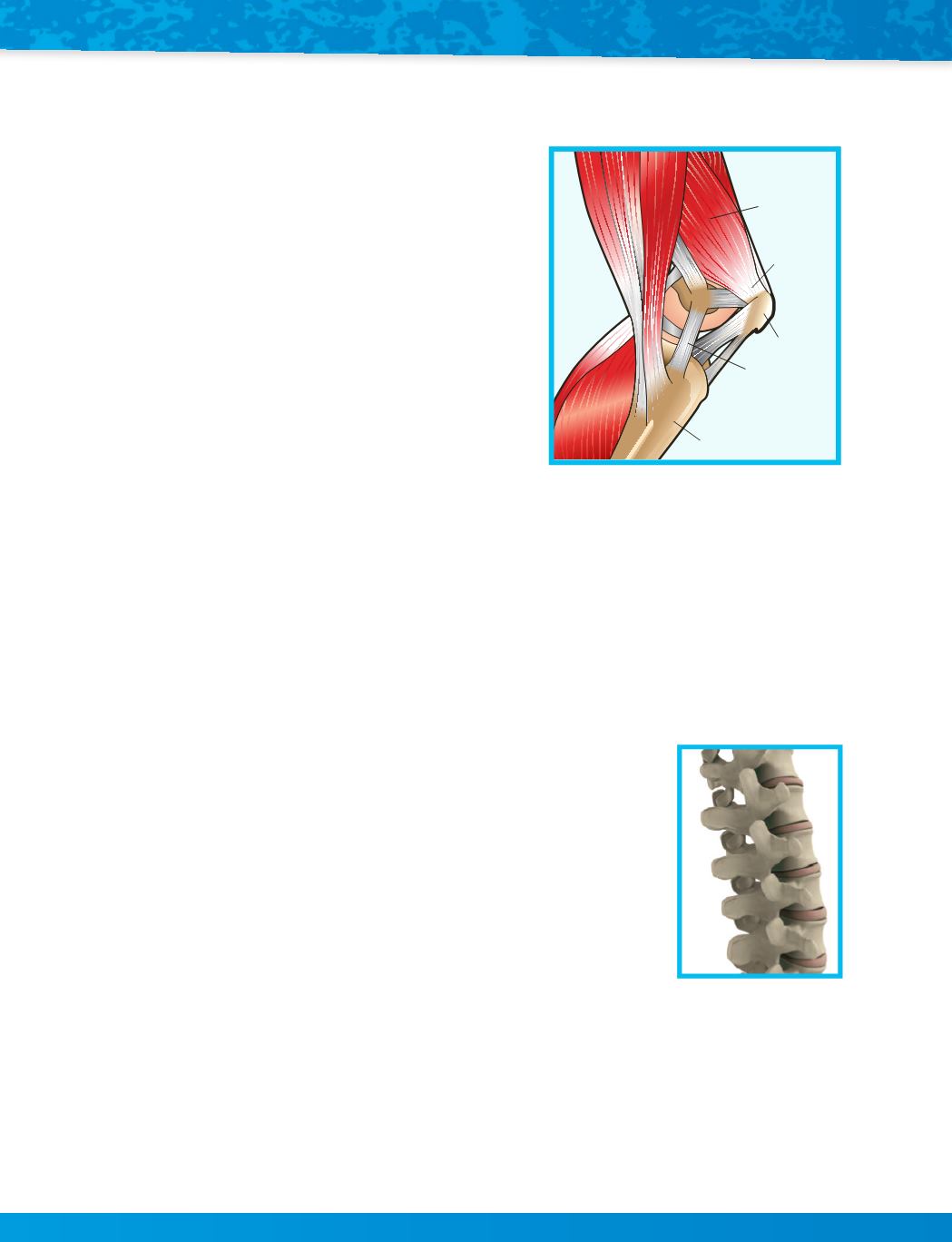
Bones are held in place by connective
tissues.
Cartilage
is a kind of
connective tissue. It is found at the
ends of the bones. Cartilage protects
the bones and helps joints move
smoothly.
Ligaments
are another type of connective tissue. They
hold the bones together at the joints.
Bones don’t move by themselves. Muscles move bones. Together
bones and muscles allow movement to happen at joints. How?
Tendons
, another type of connective tissue, connect muscles to
bones. When a muscle
contracts
, or shortens, the tendons pull the
bones, causing movement.
Here are some super flexible parts of your body.
Spine
The spine is the backbone of the body.
The 26 bones in the spine are called vertebrae.
They have cartilage between them, allowing the spine
to bend and twist.
Shoulder
The scapula, or shoulder blade, and the
arm are connected by many muscles and ligaments.
This flexible shoulder joint allows you to swing your
arm in a full circle. Try it!
Hip
The femur, or thighbone, is the longest bone in your body.
One end of it fits perfectly into your pelvis at your hip. The hip joint
allows you to kick to the front and to the side.
The spine
76
Leg Muscle Diagram REDO 2 Pg76
Tibia
Patella
Ligament
Tendon
Muscle