


 44 / 116

Adaptations for Getting Food
Animals can’t make their own food. They have to find and eat food to
survive. Every animal has structures and behaviors for getting the food it
needs to survive in its environment.
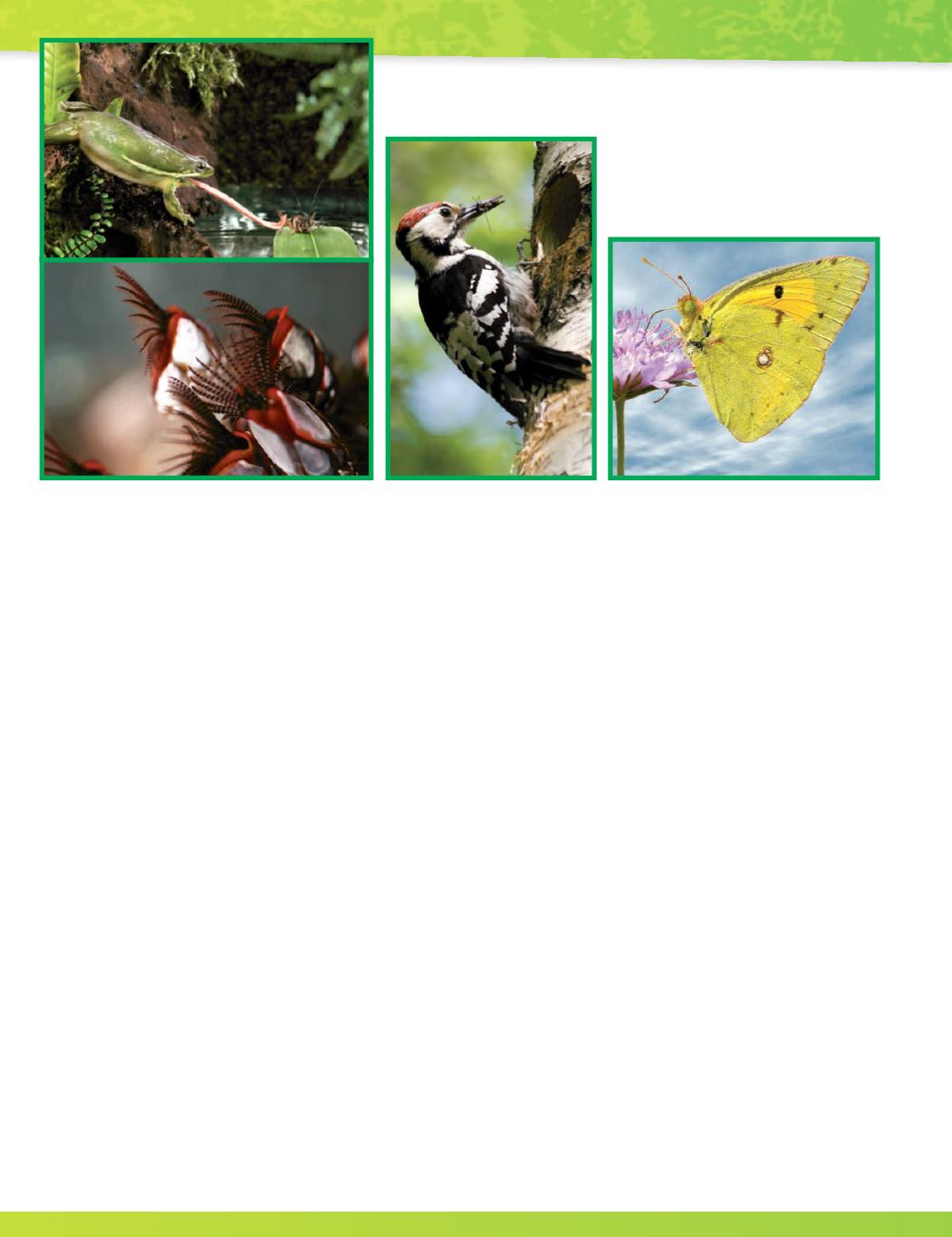
Frogs eat insects. Frogs have long tongues with a sticky pad on the end.
The frog shoots out its long tongue at an insect. The insect sticks to the
pad. The long tongue and sticky pad are adaptations that allow frogs to
catch insects to eat.
Barnacles don’t move to get their food. They wait for food to drift by.
Barnacles have specialized rakes they wave in the water. Small organisms
get caught in the rakes. Specialized rakes are adaptations that allow
barnacles to get the food they need to survive in their environment.
Woodpeckers eat insects in trees. They have strong, sharp beaks and
strong neck muscles. Woodpeckers chip away bark and dead wood to
find the insects they eat. Sharp, strong beaks and strong neck muscles are
adaptations that allow woodpeckers to get food in their environment.
Butterflies eat nectar from flowers. To reach into deep, narrow flowers,
a butterfly has a long, strawlike mouth called a
proboscis
. The proboscis
is an adaptation that allows the butterfly to get food.
Any structure or behavior of an animal that allows it to get food in its
environment is an adaptation for feeding. What adaptations do you have
for getting food?
These animals have
different structures to
help them get food.
44